Richard Lindzen – The Imaginary Climate Crisis – How can we Change the Message

Richard Lindzen – The Imaginary Climate Crisis – How can we Change the Message

A Zoom presentation arranged by the ICSF and Clintel held on 31 March 2021. Re-recorded on 2nd April due to disruptions by trolls who failed to prevent a very informative and insightful Zoom talk by Professor Lindzen. Professor Emeritus Richard S Lindzen is a world‐renowned dynamical meteorologist with interests in the broad topics of climate, planetary waves, monsoon meteorology, planetary atmospheres and hydrodynamic instability. His research involved studies of the role of the tropics in mid‐latitude weather and global heat transport, the moisture budget and its role in global change, the origins of ice ages, seasonal effects in atmospheric transport, …

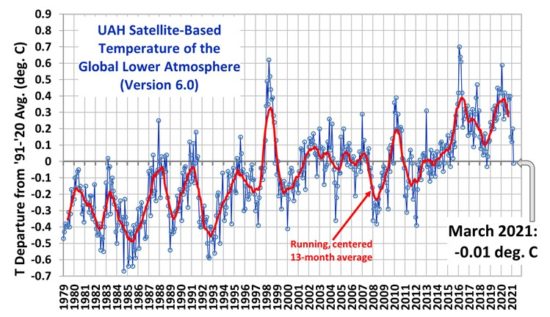
UAH Global Temperature Update for March 2021: -0.01 deg. C

UAH Global Temperature Update for March 2021: -0.01 deg. C

Dr. Roy Spencer | April 2, 2021 The Version 6.0 global average lower tropospheric temperature (LT) anomaly for March, 2021 was -0.01 deg. C, down substantially from the February, 2021 value of +0.20 deg. C. REMINDER: We have changed the 30-year averaging period from which we compute anomalies to 1991-2020, from the old period 1981-2010. This change does not affect the temperature trends. Right on time, the maximum impact from the current La Nina is finally being felt on global tropospheric temperatures. The global average oceanic tropospheric temperature anomaly is -0.07 deg. C, the lowest since November 2013. The tropical …

Global temperature dropped to the pause level of the early 2000s

Global temperature dropped to the pause level of the early 2000s

Dr. Antero Ollila | April 3, 2021 The satellite temperature measurement of the March has been published, Figure 1. Figure 2. Monthly values of satellite temperature UAH in 2002–2021. The impact of ENSO events has been calculated using the formula 0.1*ONI (Oceanic Nino Index) applying a delay of five months. The temperature of March has dropped to pause temperature average of 2002-2014, generally known as temperature pause or hiatus. Since October 2010, the temperature has dropped from 0.4 °C in October to 0.15 °C in December, to 0.12 °C in January and to -0.01 °C in March. Temperature changes from …

Inside the Church of Climate

Inside the Church of Climate

American Institute for Economic Research | Robert L. Bradley Jr. – April 2, 2021 At an environmental forum, Julian Simon once asked: “How many people here believe that the earth is increasingly polluted and that our natural resources are being exhausted?” After a roomful of hands shot up, Simon then asked: “Is there any evidence that could dissuade you?” Encountering silence, he followed up: “Is there any evidence I could give you—anything at all—that would lead you to reconsider these assumptions?” After more silence, Simon answered: “Well, excuse me. I’m not dressed for church.” Today’s Church of Climate holds three …

Perceptions of climate impacts at odds with scientific data

Perceptions of climate impacts at odds with scientific data

Global Warming Policy Forum Press Release | April 1, 2021 A new Savanta ComRes poll commissioned by the Global Warming Policy Forum (GWPF) has revealed low levels of public awareness of key trends relating to climate change and international development. The survey of British adults suggests that the public perceive the impacts of climate change to be more negative than the academic research would suggest. However, there is also a significant minority of the public who say they are ‘not very’ or ‘not at all’ concerned by climate change. In total, 28% of respondents said they were ‘very concerned’ about …

John Tyndall, Atmospheric Researcher. Part 2: The Water Vapour Dispute with Gustav Magnus

John Tyndall, Atmospheric Researcher. Part 2: The Water Vapour Dispute with Gustav Magnus

Picturing Meteorology | Dec. 31, 2017 This guest post is by Roland Jackson. Part 1 explained Tyndall’s work on carbon dioxide, and fog horns. Jackson’s biography, The Ascent of John Tyndall, will be published by Oxford University Press on March 22. You can follow him on Twitter @Roland_Jackson or @ProfTyndall. John Tyndall’s apparatus for measuring the heat absorption of gases. The frontispiece of Tyndall’s book Contributions to Molecular Physics in the Domain of Radiant Heat (London: Longmans, Green, and co., 1872).   Scanned from the personal collection of Roland Jackson. John Tyndall’s apparatus for measuring the heat absorption of gases. …

John Tyndall, Atmospheric Researcher. Part 1: Carbon Dioxide and Fog Horns

John Tyndall, Atmospheric Researcher. Part 1: Carbon Dioxide and Fog Horns

Picturing Meteorology | Dec. 31, 2017 When you say “Tyndall” to an atmospheric scientist today, they are likely to think of the Tyndall Centre, Great Britain’s premier unit for climate change research. But the Centre is named for a man, whose adventurous career in 19th century science deserves an extensive biography. Roland Jackson has written that book, The Ascent of John Tyndall, which will be published by Oxford University Press March 22, 2018. The former Head of the Science Museum in London and then Chief Executive of the British Science Association has contributed two guest posts exploring Tyndall’s impact on …

Climate Dynamics: The True Control Knob of Climate Change

Climate Dynamics: The True Control Knob of Climate Change

by Jim Steele | March 27, 2021 The earth’s energy equilibrium is determined by the balance between incoming solar radiation versus radiative cooling that emits infrared radiation back to space. Water vapor primarily and CO2 can slow radiative cooling via the greenhouse effect. I am most grateful for the greenhouse effect. Without it the earth’s average temperature would hover near 0°F instead of our currently more livable 59°F. But in addition to any radiative effects, the earth’s global average temperature is determined by a variety of climate dynamics, such as the balance between ocean heat storage and heat ventilation. This …

Greenhouse theory refuted by 17 papers finding Co2 can make the climate colder

Greenhouse theory refuted by 17 papers finding Co2 can make the climate colder

“CO2 rise of 0.008% too tiny to matter.” By James G Matkin New research from 17 papers refutes Greenhouse theory with stunning findings that Co2 makes the climate colder, Co2 lags temperature is so tiny it can be “neglected.” The earth is cooling yet Co2 emissions are rising is there a connection? Yes according the extensive research of Thomas Alimendinger from Zurich, Switzerland. “The second and definite evidence is delivered by the here first mentioned warming-up experiments of air and of pure carbon-dioxide in the presence of thermal radiation, which even revealed a temperature reduction by carbon-dioxide, apart from the …